









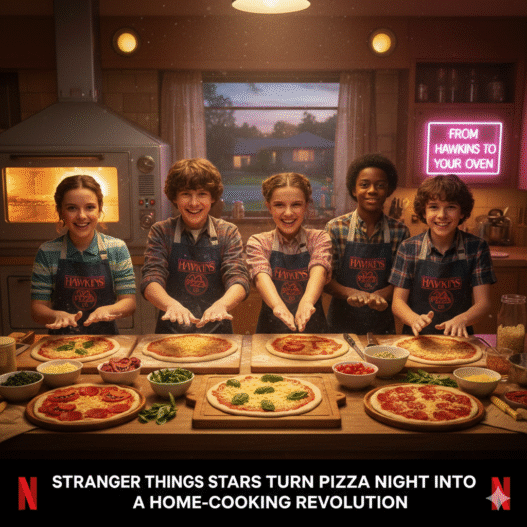


The Upside Down isn’t the only thing intimidating the cast of Stranger Things. In a recent installment of The New York Times Cooking’s “Pizza Interview” series, Finn Wolfhard and Natalia Dyer met a surprisingly relatable foe: pizza dough. These Stranger Things Stars are not just actors, they are home cooks too.
In the NYT kitchen, the two stars of the Netflix phenomenon fumbled, laughed, and nervously shaped dough like every home cook has at some point. Their appearance, originally framed as Finn Wolfhard and Natalia Dyer of ‘Stranger Things’ Face a New Foe: Pizza Dough, became something bigger than a promo stop. It turned into a reminder of why pizza is the most democratic food on earth—and why your next Friday night could be the moment you finally make the best pizza of your life at home.
As Stranger Things Stars, they remind us that cooking can bring everyone together in the most delightful ways.
For pizza lovers and Stranger Things fans alike, this crossover is irresistible. It’s celebrity culture meeting comfort food, Hawkins meeting your home oven, and it offers a clear message: great pizza isn’t about being a chef. It’s about being willing to get flour on your sweater.
Celebrity Pizza Confessions: From Chain Slices to Cast Iron Steaks
Celebrating the Culinary Skills of Stranger Things Stars
Before they ever picked up a peel, Wolfhard and Dyer were exactly where most of us started: living off delivery and nostalgia. Wolfhard grew up in a rotation that reads like a roll call of American pizza chains—Domino’s, Papa John’s, Pizza Hut—while Dyer proudly described herself as a “cheese kind of girl,” devoted to classic pies and that iconic garlic dipping sauce.
On set, their diets swung between perfectly composed catering and what Dyer jokingly framed as survival mode: Lunchables, Danimals, and whatever else could be inhaled between takes. Anyone juggling a full-time job and a side project (or three) will recognize the pattern: convenience first, actual cooking second.
Yet even in that chaos, the cast found its culinary MVP. Both actors pointed to Joe Keery—the beloved Steve Harrington—as the real kitchen hero. His go‑to? A “simple, but perfect” steak with chimichurri that apparently stops conversations around the table. It’s a telling detail. The best food on any set, or in any home, is rarely the most complicated. It’s simple food done with care.
Wolfhard, for his part, is quietly building his own reputation as a serious home cook. He talks about his love of Asian cuisine, hosting dinner parties centered on Japanese hot pot (“a bit too salty,” he admits with the self‑awareness of someone who has watched a friend’s face after that first bite) and a recent success: kimchi stew with pork belly. His experiments matter for home cooks because they prove a point: if you can follow your curiosity into kimchi jjigae, you can absolutely learn to stretch a dough and top a pizza.
And that’s where this story shifts from celebrity anecdote to blueprint. If Finn and Natalia can stare down an elastic, slightly terrifying dough ball with cameras rolling, you can do it on a quiet weeknight with a podcast in the background.
Why Pizza Dough Intimidates Everyone—And Why That’s Good News
In the NYT kitchen, Wolfhard and Dyer admitted what most of us won’t say out loud: pizza dough is intimidating. It bubbles, it resists, it sticks. It feels alive. Dyer’s comment that she found dough “intimidating” is exactly the crack in the door that hesitant home cooks need.
Because here’s the truth: the moment you go from frozen pizza to homemade is the moment you cross a line from consumer to creator. And dough is the gatekeeper. Once you understand that it’s just flour, water, yeast, salt, and time, that gate swings open.
The final season of Stranger Things is drenched in nostalgia—kids on bikes, mall food courts, basement hangouts. Pizza fits perfectly into that universe. It’s the food of sleepovers, late‑night rehearsals, and messy friendships. But when you bring pizza into your own kitchen, it becomes something more: a ritual. You mix, you knead, you wait, you share.
And that’s why their nervous laughter over a ball of dough matters. It says: this is allowed to be awkward. You’re allowed to mess it up. The path from chain slices to your own best home pizza oven masterpiece is not a straight line—it’s a series of slightly wonky circles that get better each time.
Your Blueprint for a Next‑Level Home Pizza Night
Channel your inner Hawkins crew: the courage to face otherworldly monsters starts with the courage to turn on your oven. Here’s how to turn a casual pizza night into a ritual that rivals your favorite pizzeria.
1. Master the Foundation: Dough Is the Real Main Character
Every great pizza episode—on screen or off—starts with the same plot point: the dough.
Skip the pre‑baked crusts and par‑baked shells. When you make dough from scratch, you control everything: flavor, texture, chew, and char. The process is simpler than it looks:
- Mix flour, water, yeast, and salt.
- Let time do the heavy lifting through a long, slow cold ferment in the fridge (24–72 hours).
- Bring the dough to room temperature, gently stretch it, top it, and bake.
That overnight rest is the secret Stranger Things–style time jump that transforms basic ingredients into something complex and deeply flavorful. It also makes the dough much easier to handle—crucial for beginners who feel as “intimidated” as Dyer did.
If you want a reliable, step‑by‑step formula instead of guessing, head to Pizzaiolo.ai for a foolproof pizza dough recipe tailored to home ovens. Think of it as your friendly neighborhood Dungeon Master, guiding you through every roll, rest, and stretch.
2. Build Your Pizza Tool Kit: Leveling Up from Home Cook to Pizzaiolo
In Hawkins, a nail‑studded bat is a key tool. In your kitchen, it’s a pizza peel.
A basic pizza‑making tools kit transforms your experience from struggle to smooth:
- Pizza peel: Lets you slide your pizza into the oven with confidence instead of panic.
- Pizza stone or pizza steel: These preheated surfaces store and release massive heat, giving you that blistered, restaurant‑quality crust.
- Sharp pizza cutter or rocker: Clean slices mean toppings stay where they should—on the pizza, not smeared across your cutting board.
You don’t need a professional kitchen to make this work. Start with the essentials and upgrade over time. For a curated selection of peels, stones, and baking steels that actually deserve space in your kitchen, explore our trusted affiliate partners—each pick tested for durability, heat performance, and ease of use.
The right tools won’t just make your pizza better; they’ll make you want to make pizza more often. That’s how home rituals begin.
3. Source Artisanal Pizza Ingredients: Flavor Beyond Hawkins
Once your dough and tools are in place, toppings are where you can go full Finn Wolfhard and get adventurous. This is where his love of bold Asian flavors and Joe Keery’s simple chimichurri steak start to influence your pie.
Start with quality building blocks:
- Tomatoes: Look for true San Marzano DOP tomatoes for a bright, balanced sauce.
- Cheese: Fresh mozzarella di bufala or high‑moisture fior di latte for that iconic stretch.
- Meats: Cured salumi, spicy ‘nduja, or thoughtfully sourced pepperoni for punch.
- Flour: 00 pizza flour for a dough that’s tender, elastic, and easy to stretch thin.
From there, the Stranger Things–inspired experiments begin:
- A kimchi and pork belly pizza nodding to Wolfhard’s stew.
- A steak‑and‑chimichurri pie in honor of Joe Keery’s cast‑favorite dinner.
- A “sleepover special” with classic cheese and garlic dip for your own nostalgic nights.
If you’re a serious home pizzaiolo or a local business owner in Los Angeles—or anywhere, really—looking to upgrade your pantry, our supplier directory at ThePizzaWeekly.com/suppliers/ is a one‑stop shop for artisanal pizza ingredients, specialty flours, and bulk options.
4. Fire Up the Right Oven: From Apartment Ovens to Backyard Beasts
Your standard kitchen oven can absolutely produce a crisp, deeply satisfying pizza. But if you’re chasing that fast‑baked, leopard‑spotted, Neapolitan‑style crust you see on social media, a dedicated best home pizza oven is the upgrade that changes everything.
Modern home pizza ovens—gas or wood‑fired—regularly hit 800°F and beyond, turning raw dough into a blistered, airy, char‑freckled masterpiece in 60–90 seconds. They’re compact enough for small patios and forgiving enough for beginners, yet powerful enough to impress lifelong pizza professionals.
Consider:
- Gas ovens for ease, consistency, and quick heat‑up times.
- Wood‑fired ovens for theater, smoky flavor, and the primal satisfaction of tending a fire.
Your pizza oven becomes the new center of gravity for your gatherings, a bit like the Wheeler basement or the Hawkins mall food court—only with better food. For tested, top‑rated models across budgets and spaces, explore our curated recommendations and find the best home pizza oven for your setup.
Stranger Things Pizza FAQ: Your Burning Questions, Answered
What’s the easiest pizza dough recipe for beginners?
The easiest beginner‑friendly dough uses four ingredients:Flour+Water+Yeast+Salt\text{Flour} + \text{Water} + \text{Yeast} + \text{Salt}Flour+Water+Yeast+Salt
The real “fifth ingredient” is time. Mix the dough, then let it cold ferment in the refrigerator for 24–72 hours. This slow rise:
- Develops deep, complex flavor.
- Makes the dough more relaxed and easier to stretch.
- Fits seamlessly into a busy schedule—mix on Wednesday, bake on Friday.
For a detailed, no‑guesswork version with measurements, timing, and troubleshooting tips, visit Pizzaiolo.ai and follow their beginner dough recipe.
Can I make great pizza without a stone or steel?
Yes—your home oven has more power than you think. If you don’t own a pizza stone or steel yet, try this:
- Place a heavy baking sheet or cast‑iron skillet upside down on the middle rack.
- Preheat the oven to its highest setting (usually 500–550°F) for at least 30–45 minutes.
- Build your pizza on parchment paper, then slide it onto the preheated surface.
- For extra char, switch the oven to broil for the final 1–2 minutes, watching closely.
It’s not pure Neapolitan, but it will give you a remarkably crisp, chewy crust—and the confidence to keep going.
What are some of the best non‑traditional pizza toppings?
Take a cue from Finn Wolfhard’s love of Asian flavors and the cast’s playful food culture. A few ideas:
- Kimchi Pork Belly Pizza: Tomato or white base, mozzarella, sliced pork belly, kimchi, scallions, and a drizzle of sesame oil after baking.
- Chimichurri Steak Pizza: Thinly sliced grilled steak, mozzarella, charred onions, finished with bright chimichurri.
- Breakfast in Hawkins: Tomato sauce, crumbled sausage, cheddar, and an egg cracked in the center before baking.
- Mushroom & Sesame White Pie: Ricotta and mozzarella base, sautéed shiitake mushrooms, scallions, sesame seeds, and a post‑bake drizzle of sesame oil.
Non‑traditional toppings work best when you keep a few rules in mind: balance salt, fat, acid, and texture—and don’t overload the crust.
How can I get a crispy crust at home?
Crisp crust is all about heat and contact:
- Preheat your pizza stone, steel, or baking sheet for 45–60 minutes.
- Bake on the hottest setting your oven allows.
- Keep toppings modest so the dough can puff and crisp instead of steaming.
- Finish with a quick blast under the broiler if the top needs more color.
That intense initial heat sets the bottom of the crust, creates structure, and locks in the chew.
From Hawkins to Your Home Oven
The final season of Stranger Things may close the portal on Hawkins, but it opens another door—into your own kitchen. Watching Finn Wolfhard and Natalia Dyer nervously shape dough in the NYT Cooking kitchen is an invitation: you don’t need a culinary degree, sponsorships, or a wood‑fired oven in a Brooklyn loft to make serious pizza. You just need a willingness to try, to fail a little, and to try again.
With a simple dough, a few essential tools, thoughtfully sourced ingredients, and (if you’re ready) the best home pizza oven you can justify, you can turn pizza night into a ritual that rivals your favorite slice shop—no Demogorgons required.
This article contains affiliate links, which means Pizza Magazine may earn a commission if you make a purchase through them, at no extra cost to you. We only recommend products and services we genuinely believe in.